
Add a comment
Digging into the Detail with Albacappella
‹-- PreviousNext --›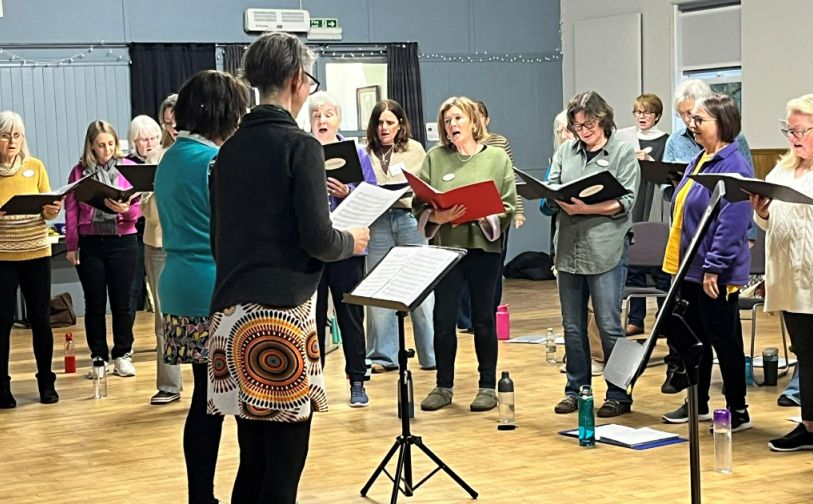
I’ve just spent a happy weekend with Albacappella at their chorus retreat just outside Aberdeen. My remit was to work with them on an arrangement they had commissioned for this year’s LABBS Convention, although we also looked at their other contest piece and did some more general technique work that will apply across the board.
Some coaching trips develop a theme that runs through all our work. Looking back on this one, it feels rather more miscellaneous in focus, and thus hard to summarise. I think this is mainly because it was organised primarily around musical detail rather than skill development, so our focus shifted according to the needs of the immediate musical context. The reason for this approach is that everyone was specifically interested in what an arranger had to say about why and how they ended up with what they were singing.
I always feel a bit of impostor syndrome when people are looking at me for insight about the arranging process, since by the time I’m coaching a chart, it’s months since I’ve worked on it, and the rationale for decisions that were very clear to me when I was in the middle of doing it have long since been buried beneath subsequent musical experiences.
A few details remain: the reason for the character of one particular section, for example, is because their director asked me to do it that way. But mostly I approach coaching the chart in the same way I approach other people’s music, reverse-engineering insights about how it’s put together from what’s on the page in the context of how arrangements work.
And of course you can still get quite a lot of insight into the arranging process by doing this. The reason the embellishment strategy of a third chorus differs from the first two in everyone’s charts is to maintain audience interest. Likewise, whilst I don’t recall specifically thinking about this last summer, the reason I’d write a couple of bars of neutral syllable accompaniment when introducing a bass melody would be to allow the ears to be drawn readily to the new locus of narrative.
On the other hand, characterising those accompanying ‘Ahs’ as avenging angels sounds like something that could be a deliberate creative intention, when in fact it was a thought that arose during the coaching process in an attempt find a timbre that matched the sense of jeopardy at that point in the story-telling.
We did have a couple of more generalised themes that emerged over the two days. One was the relationship between maintaining integrity of tone right to the end of the phrase and believability. A vocal commitment to stay with the music until it is ended comes over to the audience as an expressive commitment to its message.
Another was the way that simplifying and moderating conducting gesture cleans up the sound. The chorus’s MD is a very experienced singing teacher (and indeed performer), but has come to conducting relatively recently. It was most gratifying the way that adjusting her gestural vocabulary progressively allowed more and more of the work she has been doing on vocal craft with the chorus to become audible.


You may also like ...
|
Node 3,040
Weight = 6. Linked from Slowing things down with SpecsAppeal (4), Two tags in common [304 posts have this] A Cappella, Coaching (2) 
|
Node 2,430
Weight = 3. Three tags in common [25 posts have this] A Cappella, Arranging, Coaching (3) 
|
Node 2,600
Weight = 3. Three tags in common [25 posts have this] A Cappella, Arranging, Coaching (3) 
|
Node 2,976
Weight = 3. Three tags in common [25 posts have this] A Cappella, Arranging, Coaching (3) 
|
