
Am I Arranging in Tune?
 Okay, so it’s ultimately in the hands of singers whether they produce in-tune performances, but arrangers can have more of an influence on how well they achieve this than you might think. Here are three factors that can affect how well singers tune:
For example, in an arrangement of Take That’s I'd Wait for Life for soloist + female chorus, I originally had the opening accompaniment looking like this:

But clearly that was going to be both dull to sing (if easy to learn!), and liable to sag. The final version has exactly the same notes in it, but a more interesting experience for the singers, and keeps them in a more active relationship with pitch:

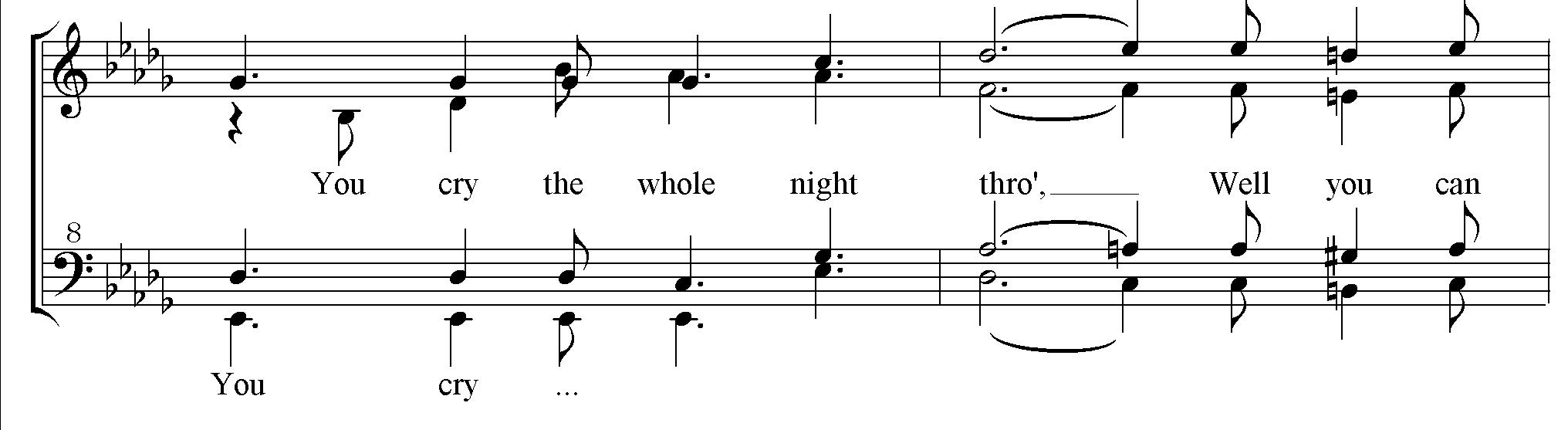
So, in this example from Cry Me a River, the bass has an octave leap, and both tenor and baritone leap up a tritone within the chord of A flat 7 on the words ‘whole night’.
The key thing here is to give the louder part the notes lower in the harmonic series – roots and 5ths rather than 3rds or 7ths. For example, some friends from IABS recently commissioned this arrangement of Embraceable You as a bass melody, so I’ve given the lead the 5th and the bari the 3rd at the opening.

Often if you hear what sounds like a slightly flat major 3rd, the problem is at least partly that it is an over-loud major 3rd; you can fix the tuning by getting the chord more into balance. So, as arrangers, we can save the groups we write for rehearsal time by building the harmonies in such a way that the group’s habitual balance is the one needed for optimal tuning.
This is not an exhaustive list, of course – and I may return to this subject at a later date!


You may also like ...
|
Node 2,780
Weight = 6. Linked from Exploring Arrangement Choices with Amersham A Cappella (4), Two tags in common [147 posts have this] A Cappella, Arranging (2) 
|
Node 2,242
Weight = 6. Linked from Exploring New Music with Signature (4), Two tags in common [147 posts have this] A Cappella, Arranging (2) 
|
Node 1,174
Weight = 6. Linked from Jiggering with Your Own Arrangements (4), Two tags in common [147 posts have this] A Cappella, Arranging (2) 
|
Node 2,684
Weight = 6. Linked from Soapbox: Technical Difficulty is not the Same as High Standards (4), Two tags in common [147 posts have this] A Cappella, Arranging (2) 
|
...found this helpful?
I provide this content free of charge, because I like to be helpful. If you have found it useful, you may wish to make a donation to the causes I support to say thank you.
Archive by date
- 2024 (17 posts)
- 2023 (51 posts)
- 2022 (51 posts)
- 2021 (58 posts)
- 2020 (80 posts)
- 2019 (63 posts)
- 2018 (76 posts)
- 2017 (84 posts)
- 2016 (85 posts)
- 2015 (88 posts)
- 2014 (92 posts)
- 2013 (97 posts)
- 2012 (127 posts)
- 2011 (120 posts)
- 2010 (117 posts)
- 2009 (154 posts)
- 2008 (10 posts)
