Opening Up (Literally) for Coaching

Opening up for ventilationOpening up for ventilation

Now that up to 6 people can meet indoors in England, and non-professional singing groups of up to 6 can also re-start indoor rehearsing, I am once again able to welcome individuals and small ensembles for coaching. I’ll send you a copy of my formal risk assessment on booking, but here are the key safety measures I’ll have in place to protect us all:

Rehearsing Remotely in Granite City

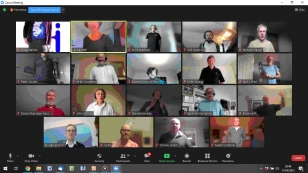
GCCmay21I spent Tuesday evening with my friends up at Granite City Chorus, as guest director for an evening’s rehearsal. Their MD Peter is currently on paternity leave, so they got this date with me in the diary some months ago so the Music Team who are running the rest of their rehearsals could look forward to having a break and the chance to be chorus members rather than leaders. Peter did pop in for a few minutes, but I didn’t get a screen-shot until after he had gone, so you’ll have to take my word for it that his baby looks adorable.

One of the things I reflected on afterwards was how in some ways it is an easier task to deputise for a rehearsal in an online mode compared to working in-person. Well, to start with, I wouldn’t pop up top Aberdeen for 90 mins from Birmingham in the normal run of things!

Soapbox: How to Stop the Music

soapbox‘Wait! What?’ I hear you cry on reading that title. ‘Why do we want to stop the music?’ Then you remember that this blog talks quite a lot about the choral rehearsal and in that context actually you need to stop the music quite regularly so you can work on stuff. It’s very inefficient to carry on to the end every time, especially when the bit the singers need help with happens in bar 3.

The question arose in a Music Team training session about leading singers in small groups. We had discussed the two modes of leading the singing available, as a conductor, or as a member of the ensemble, and the parallels and differences between them. (Actually that could merit a blog post of its own one of these days.) We’d covered the process of starting the music in each mode, but hadn’t specifically addressed how to stop it.

Executive Summary of Barbershop, Part 2: the Overtone

In my last post, about my talk on barbershop for Scunthorpe Choral Society, we got to the point where someone asked a really good question, and then it all got too long to answer in one blog post. So we are resuming here, refreshed, and having had a bit more thinking time to consider the question: can you generate the characteristic audible overtones of barbershop expanded sound/lock and ring when making a multi-track recording with yourself?

I’m always a bit slow when thinking about the physics of sound, not least because when given the choice at university, I opted to study Italian for a year instead of acoustics, thinking it would be more useful for a singer. But I’ve learned some stuff since, and my understanding of timbre, vowel perception, and the harmonic series makes me think that in theory, yes, you should be able to do this. The overtones fall well within the range of audible sound picked up by microphones, so the frequencies to be reinforced are clearly present in the sound. Moreover, you’d think that one person singing all the parts has a head start on getting the sound well-matched.

Executive Summary of the World of Barbershop

.

Last Thursday an invitation from Scunthorpe Choral Society had me giving a short presentation on barbershop choruses as part of their ongoing series of visiting speakers. I was given the remit of talking about what is different in barbershop from other choirs (there’s lots in common too of course), and with a time slot of 15 minutes, it made me think quite ruthlessly about what were the essentials to share.

So, I started off with a whistlestop account of the genre’s origins and history, which for these purposes could fit into 6 moments:

Human Beings of the Atlantic Coast

Last Thursday took me zooming over to Portugal to lead a seminar on ‘Working with Human Beings’ with the students of the Atlantic Coast International Conducting Academy. Every time I work with a group of conductors I remark on the dedication and insight they collectively bring to the discussion, and this time I was also struck by their sense of shared ethos and values.

This is clearly in part a function of the course itself: course leader Luis Clemente spoke to me before we started about the goal to produce ‘responsible’ conductors. The contributions the participants made to discussions bore this out, showing not only a high level of thoughtfulness and care in how they were articulated, but also a shared philosophy that saw the ensemble as active artistic participants in the production of music, not just the conductor’s ‘instrument’.

The PandeMusic app and How You Can Help Ongoing Research into Covid and Music-Making

PandeMusicOn Thursday I attended a session for Association of British Choral Directors members on a new app called PandeMusic. They’ve not done a major launch yet because it is taking a while to get it into the Apple Store, but it is already available for Android – indeed I downloaded and had it up and running during the session, submitting my first report in less time than it took the presenters to explain it. So I don’t think it’s premature to tell everyone else about it.

The app is a collaboration between abcd and Making Music. It is the brainchild of Martin Ashley, who gave a presentation on what it does, and why, and was developed by John Willetts, who gave a demo of how to use it.

Gesture Height and Centre of Gravity

When teaching choral conducting we generally encourage people to use a gesture space in which their ictus lands not too far above their belly-button, as this tends to facilitate a deeper-seated breath in the singers. But sometimes the physical circumstances of your performing environment necessitate a higher gesture in order for it to be seen, and the question then becomes: how do you prevent this having a negative impact on vocal production?

This post was inspired by watching a video of someone who was managing this well.

...found this helpful?

I provide this content free of charge, because I like to be helpful. If you have found it useful, you may wish to make a donation to the causes I support to say thank you.


Archive by date

Syndicate content