Charisma

A Charismatic Encounter with Blair Brown

blairkeynote

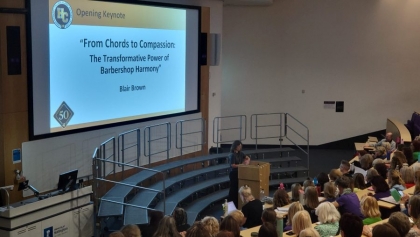
It’s a good long while since I’ve written about musical charisma, which was one of my regular topics of interest in the early years of this blog. If I’d stayed in academia, that would have been the area for my next scholarly monograph, emerging out of ideas I had to leave to one side as I wrote my book on choral conducting. But Blair Brown’s keynote speech at LABBS Harmony College got me thinking about it again.

In general culture, we tend to regard charisma as something that inheres to the individual, as a special or magical quality. However, the sociology of charisma suggests that it is something that is experienced in particular circumstances, arising from the relationships between members of a group as well as with its leader. Certainly some people are more adept at galvanising charismatic experiences within these circumstances, and indeed at facilitating their set-up, but they do it using somewhat standardised – and thus analysable – techniques rather than by any inherent magic. (Though as we shall see later, the belief in this magic is implicated in making a group susceptible to charismatic encounters.)

The Culture Code and Charismatic Social Structures

I spent a good deal of late 2019 and early 2020 thinking about Daniel Coyle’s The Culture Code for various projects, none of which really accommodated a set of tangential thoughts the book sparked. So they’ve been sitting in a notebook waiting for the moment to be developed, which they signalled by waking me up in the middle of the night and demanding to be thought about. So apparently it’s time.

These thoughts were about some interesting resonances between the behaviours Coyle identifies as being common to successful groups and organisations, and those identified by Raymond Bradley in charismatic organisations. The comparison is interesting both for the overlaps and the differences.

As a quick refresher, Coyle’s three main elements to a sense of belonging are:

1. Build Safety
2. Share Vulnerability
3. Set Purpose

The Myth of the Power of Singing: Part 4

The previous two posts in this series examined, respectively, the problems in using pseudoscience to promote singing, and the negative aspects of choral culture that the Myth of the power of Singing serves to hide. This post examines the issues the Myth presents for the scholar-practioner, creating a structural conflict between the two halves of the role.

The scholar-practitioner’s dilemma

The scholar-practitioner arguably always has a tricky line to tread. As a scholar they are committed to ideals of objectivity and transparency; as a practitioner they clearly have skin in the game. The prevailing narrative that singing is always and inherently a Good Thing amplifies this conflict of interest by eliding the distinction between practice and advocacy for that practice. The result is a tendency to build mythological assumptions into research design.

Some Ideas to Sleep On…

walkercoverOn my way out to Nashville for Harmony University, I picked up Matthew Walker’s book Why We Sleep at Manchester Piccadilly station, as a likely-looking good read for the journey. Not only was I right about that, but the things I learned from it interacted in interesting ways with the material I was teaching all week.

The headline take-away from the book is this: please make sure you give yourself enough opportunity to sleep properly, for the sake of both your health and your effectiveness in everything you do. There’s nothing like detailed empirical substantiation of what you knew to be common sense to motivate you to be more sensible.

But onto more specific, indeed, niche take-aways…

Loved-Up with LABBS

LABBS Beacon of Harmony: displayed in the Convention history roomLABBS Beacon of Harmony: displayed in the Convention history roomLast weekend saw the 40th-anniversary celebrations of the Ladies Association of British Barbershop Singers culminate at our annual Convention. I chose my title to report on it for both personal and analytical reasons. I’ll be selfish and talk about the personal stuff first, and then leave you with the broader analysis of the event, as the more useful take-away for other people wanting to craft wonderful experiences for their memberships (or, as I felt it this weekend, their tribes.)

So, I was feeling specifically loved-up as an arranger. The most obvious reason for this was being honoured with one of the 40th anniversary awards for contributions to the association, specifically for my arranging efforts. Which was lovely in itself, but they also said a whole load of other nice things about me before calling me up to receive it. There is nothing like being told publicly that you’ve made a difference to make you feel like you belong. Oh, I’m getting all teary again just writing this. Do excuse me.

LABBS Harmony College 2016: Initial Reactions

Nickie James welcomes the assembled delegatesNickie James welcomes the assembled delegatesI am just home from a rather wonderful weekend with the Ladies Association of British Barbershop Singers, in which singers from all over the country gathered in Nottingham for a weekend of education and musical bonding. LABBS hasn’t used the Harmony College format for some years, having focused instead on themed and regional events on a rolling schedule. This has had the advantage of reaching more of the membership in total, as well as allowing those with multiple roles (quartet singer and chorus director, for instance) to access education for each. But there is a buzz about a big occasion like this that anyone who was there would not have wanted to miss.

I have, as you’d imagine, a pile of notes about things I learned and ideas I want to explore, both from the Directors Stream I was running and the plenary sessions. But in the first instance, as I’m writing this the morning after I got home, the impressions I’m processing are about this sense of occasion, and how it impacts on the learning process.

Creating a Charismatic Encounter: LABBS Directors Weekend, Part 5

Final Thoughts

Well, not final thoughts ever about this event. In fact, I have several stacks of notes on things I learned or observed or discovered during the course of the weekend that I have yet to get around to writing about. It was after all intended to be the kind of event that would affect its participants for months if not years into the future. But I think I’m nearly done processing my thoughts about it as a charismatic encounter.

Okay, that’s weird. I stopped to have a think after writing that first paragraph, then after a few minutes looking back to the start of the event, remembering what it felt like as people arrived, I realised my pulse was faster and my adrenaline levels back up again. Even while I was remembering how pleasantly surprised I had been to find myself feeling calmer and less nervous than I had expected.

Creating a Charismatic Encounter: LABBS Directors Weekend, Part 4

Communion

The key marker of the charismatic encounter isn’t, as is commonly supposed, anything to do with the personal qualities of a leader, but in the emotional experience of the participants. The characteristic sensation is a heightened, emotionally labile state of euphoria and love, that theorist of charisma have called ‘communion’ or ‘flux’.

Things that a leader does are often implicated in creating (or indeed preventing) this feeling, principally providing a Cause to line people’s sense of purpose up in the same direction, and a sense of Crisis to energise them into action. But how that emotional energy operates within the group depends significantly on the structure of interpersonal bonds within that group. Three factors are particularly important in setting this up, and this is how I factored them into my planning for the LABBS Directors Weekend in July.

...found this helpful?

I provide this content free of charge, because I like to be helpful. If you have found it useful, you may wish to make a donation to the causes I support to say thank you.


Archive by date

Syndicate content Syndicate content