Coaching

The Red Rosettes and the Song as Performance Guide

redrosettesWednesday night took up to Preston to spend an evening working with the Red Rosettes. In many ways it felt like a classic evening's coaching for me in its focus on exploring the musical material of the song and arrangement as a route to understand its emotional and narrative shape.

We started off by playing with different styles of rhythmic characterisation (discovering a preference in this instance for sling swing and stretch swing), and as so often happens, as soon as the rhythmic feel came into focus, all sorts of other performance details became both more interesting and better executed throughout the chorus. Clarity in musical shape produced better technical control and a more distinctive performance persona.

Norwich Harmony, and the Relationship between Voice and Imagination

norwichThursday saw me out East to coach Norwich Harmony at the start of the convention preparation season. They have been making significant strides in recent years in their consistency of control over matters of vocal production and unit sound, and it was interesting to hear how these efforts played out working on different parts of their repertoire.

To start with, there was a clear difference in technical control between a piece they have only recently learned and one that has been in their repertoire for a couple of years. It’s one of the endless dilemmas in developing a chorus that, while keeping songs in the repertoire for longer gives opportunities for depth of learning as familiarity with content frees up attention for other matters, at the same time, each song tends to act as a snap-shot of the skill level the singers had when it was first introduced.

Wednesday in Windsor

windsorwarmupWednesday took me down to Windsor to work current BABS silver medallists, The Royal Harmonics. I have arranged for them several times in recent years, but this was the first time we had made music together in person - indeed, it was also the first time I heard two of my arrangements sung live.

Part of the evening's agenda was to work on the most recent of my arrangements they had commissioned, and it was at that perfect point in the rehearsal process to coach where the singers were secure enough on it not to be wasting mental effort on memory tasks, but still fresh enough on it to be very flexible in adapting their performance.

Harmony in Wessex

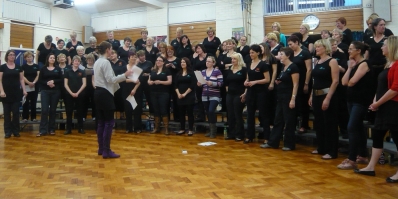
Jane Fielding warms up the chorusJane Fielding warms up the chorusSaturday took me down to Poole to work with Wessex Harmony and their director Dyrck Lamble. Dyrck had set an agenda for the day that involved breadth of repertoire rather than intensive coaching on just a couple of pieces, and we spent chunks of 20 minutes each on several repertoire songs interspersed between the work on the music they are preparing for the Ladies Association of British Barbershop Singers Convention in October.

As a result, we covered noticeably more different techniques and approaches than one would in a coaching session that had a narrower repertoire focus – and I found it made me much more aware of the techniques of prioritising. At the same time, of course, it gave us less chance to embed skills, and thus leaves the chorus not only with a longer list of things to work on, but also more responsibility to do so in order to make sure they become secure and permanent parts of their skill base.

The Belles of Three Spires

Digging into the musical detail...Digging into the musical detail...

Wednesday took me off to Coventry to work with the Belles of Three Spires under their new director, Lucy Edmonds. New, perhaps, but clearly organised – Lucy had booked the coaching session several weeks before she was even due to take up the post.

I have reflected before on how you get different benefits from seeking coaching input at different phases in the learning of a piece: at the earlier stages more of the singers’ brains need to be tied up with remembering what they’re doing, which can be an obstacle, whilst at the later stage you are contending with more deeply ingrained habits, which is a different kind of obstacle.

We spent a fair chunk of the evening on a very new song.

Coaching with Phoenix

Phoenixjul2012Tuesday evening saw me back with Phoenix chorus for an evening's coaching - nice not to leave it for six years before a re-match this time! My primary remit was to work with them on an arrangement they had commissioned from me last year, and which they have scheduled to perform in a couple of shows this September, though we also looked at a couple of other pieces to refresh our musical palate.

Most of our work was in the realms of musical characterisation, bringing out texture and colour implicit in the musical shapes. I always tend to think of this process as one of sculpting: developing the flat canvas of beautiful vocal tone into a more three-dimensional musical shape.

LABBS Quartet Prelims

And at the end of the day, the draw for ConventionAnd at the end of the day, the draw for ConventionOn Saturday, the Ladies Association of British Barbershop Singers came to the Streetly Academy in north Birmingham to hold their preliminary contest round for quartets wishing to compete at the annual convention in the autumn. The really useful dimension of this event is not so much the competitive element (LABBS has not historically had so many quartets that we always need an elimination round for scheduling/logistical purposes), but its educational dimension.

Boudica's Daughters

iceniphysMonday evening took me back to Essex for a repeat visit to Chorus Iceni in Colchester. I last saw them at the end of April, which is a long enough interval for them to have done a good deal of consolidation, yet short enough for me to have a clear memory of the level we were working at then. As a result, it was a delight to be able to tell them that I could really hear the difference they had made during the intervening rehearsals.

Two things in particular had clearly received attention since my last visit. The first was bubbling: not only was there a much greater continuity of airflow now, but everyone got on and undertook it with a sense of purpose. It is now an accepted part of the skill set rather than perceived as a difficult (and thus resisted) task. The second is that there is a noticeably more consistent sense of legato than before; given the benefits of bubbling, this is possibly not a coincidence.

...found this helpful?

I provide this content free of charge, because I like to be helpful. If you have found it useful, you may wish to make a donation to the causes I support to say thank you.


Archive by date

Syndicate content Syndicate content