A Cappella

A Busy Night with Cleeve Harmony

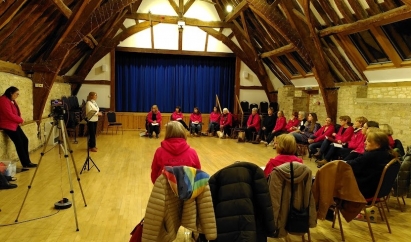
Natalie Feddon addressing the chorusNatalie Feddon addressing the chorus

It was all happening at Cleeve Harmony’s chorus night on Wednesday. They had a visit from LABBS Chair Natalie Feddon and a new member to be welcomed into the organisation, as well as two new songs to be coached on. I was there for the latter bit, but it was fun to be there for the other bits, especially as I’d not been able to join them for their 10th birthday celebrations the week before.

The two new songs we were working on were ones I’d arranged for them back in the autumn, so one was at the ‘basically learned but still finding our way round it’ stage and the other at the ‘started learning, but only the music team has sung it together yet’ stage. One of the fun things about coaching music in this very early stage of development is that you can explore global themes such as concept and groove that shape how people feel and understand the music while they’re still getting acquainted with it.

On Voicings for Mixed Barbershop Choruses, Part 2

In my previous post, we considered why mixed barbershop presents vocal challenges that are quite distinct from the single-sex forms of the genre. (In a nutshell, the standard distribution of vocal ranges for a single-sex group is a camel, but for mixed groups is a dromedary.)

We also considered some of the impacts of this structural feature. It affects individuals singers, as quite a few in any mixed chorus are likely to end up singing out of their best range. It also affects the group as a whole, through the impact of people singing outside their best range on the sound, and/or through difficulty populating the parts in an optimum balance. That post didn’t mention the expressive impact of singing out of range, but it’s something I’ve touched upon before more than once.

On Voicings for Mixed Barbershop Choruses

I am returning to this theme as a lot of people are grappling with the challenges of making a genre developed for and within single-sex ensembles work with mixed groups. Having interacted with a number of different ensembles in various capacities in recent times, I wanted to collate what I’ve learned from them about the difficulties they’ve faced and the solutions they have found.

First, though, it is worth thinking through why mixed barbershop can prove tricky, before looking at the consequences for lived experience, and what we can do about it. This may turn into more than one post; it has the feel of a question that expands as you think about it!

Exploring Recurrent Themes with Bristol A Cappella

Some days you find similar concepts coming up repeatedly in different musical contexts; Saturday was such a day with my friends at Bristol A Cappella. One of the advantages of days like this is that you find people get quicker at applying the concepts on successive encounters, and indeed that after a while you no longer have to point out where they need to apply them, as they’re figuring it out for themselves.

One theme for the day was of staying with a note right to the end of the phrase. Linguistically, the brain pretty much moves on when you get to the last syllable of a sentence; in general conversation we don’t tend to elongate them, but go straight to drawing breath for the next utterance. But when singing, it is very audible when the attention has moved on, even if people are holding the note for the notated length. You have to stay interested in it for the tone to retain integrity.

Tuning in to BABS Directors Academy

Jay's selfie captures to joy in the roomJay's selfie captures to joy in the room

The weekend saw the first in-person BABS Directors Academy since 2020 (and my first since 2019, as I missed the last one). We had Dr Jay Dougherty as our guest educator, who brings with him a deep and abiding understanding of the barbershop style along with higher degrees and HE teaching experience in choral conducting. He is probably most known in the barbershop world for having taken over Joe Liles’s ‘Tune it or Die’ course at Harmony University, which he has made his own by drawing on research undertaken in his doctoral studies. He led front and centre with this material, dedicating three consecutive sessions on Saturday to it.

New Technical Term: Canute Passages

There are those who attempt to make music theory into a fully-rational and systematic endeavour, but those of use working at the sharp end of music-making* know that it is messier than that. Yes, you can organise a lot of it into logical patterns that help you generalise and draw inferences, but a lot of music theory is about finding ways to identify and make sense of stuff that happens in real life.

So, from the Concrete-Experiential school of music theory that brought you the Icicle 7th (Karri Quan), the Phnert (Lori Lyford) and Swooshythroughiness (me), I bring you the concept of Canute passages.

On Milestones and Skill Level

I noticed as I entered my most recent arrangement into my master list spreadsheet that the one I’m working on next will be the 250th row. I’d not been consciously counting charts, not least because it’s always a little ambiguous which ones to count. My master list doesn’t include some of my earliest efforts, nor a handful of throw-away pieces done for specific occasions (though it does include others throw-aways, such as the ones NoteOrious sang on Radio 1). And of course it doesn’t mention all the ones I started and never got round to finishing. But it does include quite a few that I don’t make available for various reasons (copyright complications, or simply that I don’t like them any more.)

But anyway, now that I’ve noticed the milestone, it sounds like quite a big number. I guess that’s what happens when you keep doing something for a lot of years.

Getting into the Flow with Bristol A Cappella

BACnov22I spent Saturday with my friends at Bristol A Cappella. It was my first visit since the pandemic, and it’s starting to feel like life is healing over the huge cut in our life narratives made by the covid hiatus. It wasn’t simply picking up where we left off in 2019 (though looking back there are some common themes), but having a shared history with a significant number of the group helped us find our way into working together again readily.

As a group, they specialise in arrangements of pop, rock and show songs, and our task was to work on two songs from musicals, which, while quite contrasting in mood and expressive impact, had some similar challenges. Both are very lyric-led, with the verses in particular being quite wordy, and the task was to find a way to capture the actorly approach to singing the source genre entails whilst supplying the musical flow that would be provided by the band in the original context. The words were absolutely essential to the expression, but we needed them also not to get in the way of the music.

...found this helpful?

I provide this content free of charge, because I like to be helpful. If you have found it useful, you may wish to make a donation to the causes I support to say thank you.


Archive by date

Syndicate content Syndicate content