Coaching

MacThree plus MacThree

Mac3 mark 1Mac3 mark 1Mac3 mark 2Mac3 mark 2

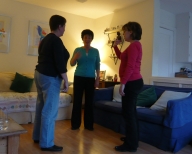
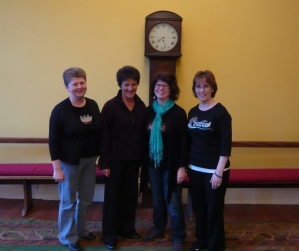
The weekend took me back up to Edinburgh to work with my friends MacFour Quartet again. I last saw them in November, when our focus was on digging deep into their songs to explore the depths of their expressive detail. With 6 weeks to go before the annual Sweet Adelines regional contest, our task this time was to get the Manager off duty and the Communicator to the fore.

We had booked the session a couple of months ago, and in the meantime miscellaneous circumstances (filed under the category of Real Life) had arisen that meant that only three of the quartet were available on each of the Friday evening and Saturday sessions. The quartet’s stickability and experience showed through in the fact that they did not consider this a reason not to go ahead. It’s as much in these matters of organisation and attitude that a quartet’s longer-term success can be gauged as in their vocal and musical prowess.

Fascinating Rhythm on South Rampart Street

FRmar12Saturday saw me back with my friends Fascinating Rhythm to work with them on David Wright’s arrangement of ‘South Rampart Street Parade’. It is a classic chart for reasons that I came away with a renewed appreciation for, and it is a good choice for them at their current stage of development: they have to raise their game to sing it, but it is a challenge within their reach. And it has that wonderful characteristic that, tricky as it is, it lifts performers – it actually helps them out-perform what they previously thought they were capable of.

NoteOrious Coaching Session

noteoriousfeb2012I spent Sunday afternoon with NoteOrious working with them on a new medley which I had arranged for them last year. (One of the challenges of writing this post is going to be making musically useful comments that make sense without naming the songs involved, as I don’t want to steal their thunder for when they want unleash it on an unsuspecting world.)

But it was a great moment in its development to work on it – they know it well enough that memory issues were infrequent and transient, but it’s not yet been so rehearsed that it becomes difficult to make changes. Indeed, it struck me that their depth of experience as a quartet shows as much in their capacity to respond quickly to coaching input and retain the changes as in their well-developed performance skills. They have become adept at making effective use of their coaching time.

Coaching by Skype

CleftomaniaCleftomaniaLast week I had my first experience of coaching by Skype. I know some people have been doing this for some years, but I had been somewhat hesitant because my experience of the technology in its early days had been quite frustrating. It was okay as an alternative to the phone – you could live with the problems of intermittent sound and the picture freezing in return for the lack of cost and novelty of the video contact. But I had reservations about using it for something that is such a full-sensory experience as coaching.

I was persuaded to give it a go, though, by the quartet Cleftomania, who are based in Portugal. I went out to work with them last year, and will be heading out there again later this month. Not unreasonably, they’d like coaching more often than once a year, but budget and logistics make this difficult. So we gave it a try.

How to Prioritise in a Coaching or Teaching Session

priority

This is a subject I was thinking about in a very particular scenario – giving feedback to competitors after a contest – and gradually realised that the thought-processes involved generalised very well to many other teaching and coaching situations I have found myself in over the years.

There are 4 basic types of factor involved.

Semantic Depletion as Coaching Strategy

A couple of years ago, I was mulling over the challenges that semantic depletion presents for performers. This is where repetition of an individual word sound (or musical element) gradually renders it meaningless by stripping it from its linguistic (or musical) context. The problem for performers is that rehearsal necessarily involves lots of repetition: so how do you refine and perfect your execution of the performance without detaching yourself from its meaning?

More recently, though, I’ve been finding that there are situations in which semantic depletion can work in your favour.

Baby Steps and the Abuse of Metaphors

jackWhen people are in the early stages of a learning process and feeling a bit daunted, you’ll often hear them being encouraged to ‘take baby steps’. Now, actually, I think this is good advice (for reasons I’ll get onto later), but the way it is usually articulated completely misreads the metaphor. People say ‘baby steps – little by little’, as if the adjective means miniature version of normal steps, rather than steps as taken by babies.

This post from the Bulletproof Musician is a case in point. I feel a bit mean picking on it, since mostly I really admire the articles over there (and if you haven’t been over there before, I encourage you to spend the rest of the afternoon having a good browse). And actually, the basic point of the article – that small incremental changes in behaviour add up over time to significant improvements in performance – is sound. But that’s kaizen, not baby steps.

MacCoaching Session

MacFourMacFourI had a trip up to Edinburgh at the weekend to work with MacFour quartet. They are a well-established ensemble with a consistent track record both as performers in their locality and in Sweet Adelines contest. Their goal for the coaching session was therefore to explore new rehearsal and performance techniques that will help them build on the skills they have already embedded. They have a really secure technical control over what they do, and wanted to focus the artistic and communicative aspects of their performance.

It was clear when we were corresponding to set up the trip that they are an organised quartet, and they like to have clear sense of method. So the task wasn’t simply a case of working on repertoire, but of providing them with processes and vocabulary they could apply beyond the specific songs we worked on.

...found this helpful?

I provide this content free of charge, because I like to be helpful. If you have found it useful, you may wish to make a donation to the causes I support to say thank you.


Archive by date

Syndicate content Syndicate content