
Coaching

Workshopping in Lichfield

The Lichfield SingersThe Lichfield Singers

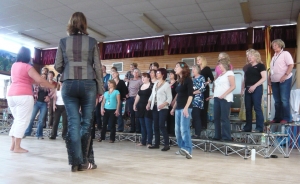
I had a happy and productive afternoon on Saturday with the Lichfield Singers, doing a workshop on the theme of Rethinking Choral Musicianship. One of the benefits of customising these workshops to individual choirs is that not only do they get the workshop time focused on the music they are currently working on, but the things we learn together are also specific to that occasion. I love that sense of knowledge arising from a particular context, and the feeling that we all go home slightly changed from when we arrived after the experience of working together.

Barbershop in Ireland

Note-Orious 8: International silver medallists Note-Orious sing with National silver medallists Note-Orious 4 in the afterglowNote-Orious 8: International silver medallists Note-Orious sing with National silver medallists Note-Orious 4 in the afterglowI spent last weekend in Galway as a judge for the Irish Association of Barbershop Singers’ convention. The association is one of the world’s smallest at around 250 members, but proportionately to the population of Ireland, this is as at least as high a participation rate as in other countries, and the convention sees an impressively high proportion of them attending.

The event punches above its weight in the barbershop calendar. This is because in addition to its national contests for quartets and choruses, it has an international dimension. Many new but ambitious quartets from Europe dip their toes into the water of contest for the first time over there, so people have learned to keep an eye on the Irish Convention for the coming new talent.

Re-visiting Fascinating Rhythm

fascrhysep11Saturday took me back to Bristol to work once again with my friends in Fascinating Rhythm. They are in the final lap of their preparation for LABBS Convention next month, and sounding considerably more solid and confident in their songs than back in May.

The challenge for a coaching session at this stage of the performance preparation process is how to make changes that are significant enough to be major enhancements without disrupting the security developed in the rehearsals so far. In terms of Kotter’s model of change, you need to unfreeze to transform, but you don’t want to unfreeze too much at this stage, when most of the rehearsal focus is on re-freezing – i.e. locking in the skills and performance decisions so they can be delivered consistently at will.

Welwyn Once Again

welwynsep11On Tuesday evening I returned to work with Welwyn Harmony, whom I had last coached back in June. It was cheering to see that they had retained a lot of the things we had worked on last time, and indeed that they were generally singing with more freedom and resonance most of the time. Helpfully, they’d sent me some recordings from the previous two rehearsals, so I was able to plan not only specific areas for coaching, but also – since they had asked me to take a vocal warm-up – devise preparatory work to introduce some specific elements we would be working on.

The work was significantly more detailed this time than last, as befits a more developed phase in the rehearsal process. In June we were looking at big-picture dimensions of rhythmic characterisation, melodic behaviour and airflow. These themes arose again on Tuesday, but usually in focusing in on specific passages or moments, to integrate them into a broadly successful approach to the songs.

JaZZmine and Musical Meaning

JaZZmine and GeorginaJaZZmine and Georgina
I spent Saturday working with JaZZmine in preparation for the quartet contest at LABBS Convention next month. This will be their first contest as a quartet, though all four singers have considerable successful experience with previous ensembles. Their qualification for convention at the Prelims contest in June came two weeks after the arrival of Paula’s daughter, Georgina, by caesarean section. That they were able to participate at all under the circumstances is impressive, though they tell me it’s not a timing they’d necessarily recommend!

Bristol Fashion: Skills and Self-Confidence

BFaug11
I spent Sunday with my friends in Bristol Fashion. I think this must have been my 5th visit in a bit over two years, and they always organise glorious weather. Even though it was drizzling when I arrived this time, once the singing started, the clouds parted. (I am sure this is nothing to either with the mild climate in the south-west of England or the fact that they always invite me in the months of May-September!)

A lot of our work this time focused less on skills per se than the psychology of confidence. There were certainly skills targeted for development (clear and positive articulation of word sounds for one), but what emerged as more central to the chorus’s quality of performance was their decision to use skills already acquired. One of the things about a group that has developed a long way in a short time is that it is very easy to default back to a lower level of performance because it is in fact not very long ago that that was the norm. They have the skills to perform with real beauty and believability to when they remember to deploy them, but they find it too easy to slip back into a more ordinary state of competence that not so long ago would have pleased them, but is no longer in the league they could be.

Chords of Crystal

crystalchordsI spent Sunday up in Manchester working with Crystal Chords chorus, who are preparing for their second LABBS Convention under the direction of Monica Funnell. Their first contest together last autumn presented an ensemble that was developing fast, but still felt a little like work-in-progress. In the intervening months they have clearly settled into their new level of skills, although they still have that capacity to pick up new ideas quickly that characterises chorus that are undergoing rapid improvement.

The result was a most productive session. As a chorus, they were very open to coaching, and took evident pleasure in their discoveries and achievements. And we really got the benefit of the work on good vocal habits they have undertaken over the last year: at no point were our musical intentions held back by limitations in vocal technique.

When’s a Good Time to Ask for Feedback?

I recently had an email conversation with someone who wanted comments on an arrangement, that framed the request for feedback as a matter of urgency, as they wanted to get the teach tracks out to their chorus. As it happens, I was in a position to juggle my schedule to fit this in, but at the same time I felt it only fair to question whether this was the right moment to be doing this.

This is a conversation I used to have frequently with students in my years as a lecturer. It was a reasonably common pattern for someone to work on an essay at length and then come for feedback only a day or two before the deadline. Often this was because they either felt there was no point in bothering me while there were still things they knew needed fixing or because they were embarrassed to show me work in an obviously incomplete (and therefore as yet inadequate) state – which does feel a bit like answering the door in your pyjamas of course. Other times it had a more cynical motivation – ‘just tell me it’s going to pass’ – which I felt rather less sympathy for, but actually didn’t change the answer.

...found this helpful?

I provide this content free of charge, because I like to be helpful. If you have found it useful, you may wish to make a donation to the causes I support to say thank you.


Archive by date

Syndicate content Syndicate content